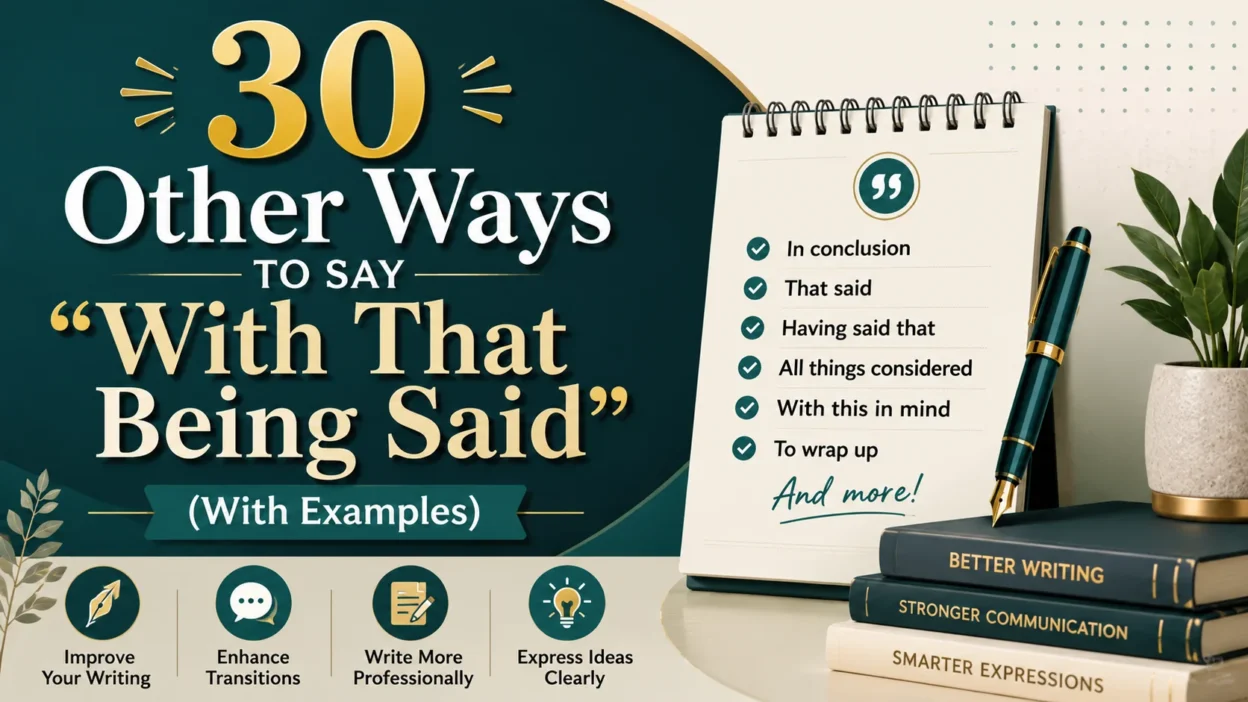
Other Ways to Say “With That Being Said” help your communication sound more natural, confident, and engaging without repeating the same phrase. Whether you’re writing an email, preparing a presentation, or having a casual conversation, using different alternative phrases, transition words, and connector words keeps your writing flow smooth and your message easy to follow. I’ve noticed that simply changing one transition can make my work feel more polished and enjoyable to read.
The phrase “with that being said” is a useful transition phrase because it helps connect ideas, move between thoughts, or introduce a conclusion. However, relying on it too often can make your writing and speaking sound repetitive, predictable, or even a little robotic. Expanding your vocabulary with synonyms, substitute phrases, and other alternatives improves readability, strengthens your communication skills, and gives your professional writing, conversational writing, and formal writing a more polished and conversational tone.
From my own experience editing reports, presentations, and emails, using meaningful transitions and natural transitions creates better communication flow, stronger idea flow, and more effective communication. The right word choice, language variety, and expression variety help you avoid repetition, improve clarity, build confidence, and keep your audience engaged. As you explore the examples in this guide, you’ll discover practical expressions that fit different situations while making your message sound clear, thoughtful, and professional.
What Does “With That Being Said” Mean?
The phrase “with that being said” is a transitional expression used to introduce a new statement that follows from or slightly contrasts with what was just mentioned. It signals that the speaker is moving from one point to another while maintaining a logical connection.
For example:
The project took longer than expected. With that being said, the final results were worth the wait.
Here, the speaker acknowledges one fact before introducing another related point.
It is commonly used in:
- Business meetings
- Emails
- Essays
- Presentations
- Everyday conversations
Is It Professional or Polite to Say “With That Being Said”?
Yes. “With that being said” is both professional and polite. It creates smooth transitions and helps organize ideas clearly.
However, using it too often can make your writing sound repetitive. Mixing in different alternatives keeps your communication fresh, polished, and more engaging.
Advantages and Disadvantages of Saying “With That Being Said”
Advantages
- Creates smooth transitions
- Sounds professional
- Connects related ideas clearly
- Works in both writing and speaking
- Easy for readers and listeners to follow
Disadvantages
- Can become repetitive
- May sound overly formal in casual conversations
- Less impactful when overused
- Some alternatives may fit specific situations better
Synonyms for “With That Being Said”
- That Said
- Having Said That
- Nevertheless
- Nonetheless
- Even So
- Still
- All Things Considered
- In Any Case
- At the Same Time
- Even Though
- Despite That
- On the Other Hand
- With This in Mind
- Keeping That in Mind
- As a Result
- Therefore
- Consequently
- Accordingly
- For That Reason
- In Conclusion
- Ultimately
- All in All
- Overall
- That Being the Case
- Given That
- In Light of That
- Considering This
- So
- Then Again
- Even Therefore
1. That Said
Meaning
A shorter version of “with that being said.”
Definition
A transition that introduces a contrasting or additional point.
Detailed Explanation
It is concise and commonly used in professional writing to acknowledge one idea before presenting another.
Scenario Example
The proposal has some risks. That said, it offers significant long-term benefits.
Best Use
Business emails, reports, presentations
Tone
Professional, concise
2. Having Said That
Meaning
Introduces a point that balances or contrasts a previous statement.
Definition
A polite transition between related ideas.
Detailed Explanation
It allows you to recognize one viewpoint while introducing another.
Scenario Example
The task is difficult. Having said that, I’m confident we can finish it together.
Best Use
Formal conversations, meetings
Tone
Professional, balanced
3. Nevertheless
Meaning
Despite what has just been mentioned.
Definition
A formal word showing contrast.
Detailed Explanation
It emphasizes that the following statement remains true despite earlier information.
Scenario Example
The weather was terrible. Nevertheless, the event continued.
Best Use
Academic and professional writing
Tone
Formal, confident
4. Nonetheless
Meaning
Even so.
Definition
Introduces an unexpected continuation.
Detailed Explanation
Very similar to nevertheless, but slightly softer.
Scenario Example
The budget is limited. Nonetheless, we can achieve our goals.
Best Use
Reports and presentations
Tone
Formal
5. Even So
Meaning
In spite of that.
Definition
A transition showing contrast.
Detailed Explanation
Works well in conversations and informal writing.
Scenario Example
The trip was exhausting. Even so, everyone enjoyed it.
Best Use
Casual conversations
Tone
Friendly
6. Still
Meaning
Despite everything.
Definition
Shows continuation despite previous information.
Detailed Explanation
A simple alternative suitable for everyday communication.
Scenario Example
It wasn’t easy. Still, we succeeded.
Best Use
Everyday conversations
Tone
Natural
7. All Things Considered
Meaning
After thinking about everything.
Definition
Summarizes all relevant factors.
Detailed Explanation
Useful when reaching a balanced conclusion.
Scenario Example
All things considered, accepting the offer seems wise.
Best Use
Decision-making discussions
Tone
Reflective
8. In Any Case
Meaning
Regardless of what has been discussed.
Definition
Moves the discussion forward.
Detailed Explanation
Helps redirect attention to the main point.
Scenario Example
In any case, let’s focus on the next steps.
Best Use
Meetings
Tone
Professional
9. At the Same Time
Meaning
While another point is also true.
Definition
Introduces another perspective.
Detailed Explanation
Shows balance rather than contradiction.
Scenario Example
The project is expensive. At the same time, it’s a valuable investment.
Best Use
Balanced discussions
Tone
Thoughtful
10. Even Though
Meaning
Although.
Definition
Introduces contrast.
Detailed Explanation
Often connects two ideas naturally.
Scenario Example
Even though we were late, we completed everything.
Best Use
Conversation
Tone
Natural
11. Despite That
Meaning
In spite of it.
Definition
Acknowledges difficulty before continuing.
Detailed Explanation
Useful for emphasizing determination.
Scenario Example
There were delays. Despite that, customer satisfaction remained high.
Best Use
Business writing
Tone
Positive
12. On the Other Hand
Meaning
Introduces another viewpoint.
Definition
Shows comparison or contrast.
Detailed Explanation
Excellent for discussing pros and cons.
Scenario Example
The role pays well. On the other hand, it requires frequent travel.
Best Use
Comparisons
Tone
Balanced
13. With This in Mind
Meaning
Considering the previous information.
Definition
Introduces a logical conclusion.
Detailed Explanation
Encourages readers to remember what was just discussed.
Scenario Example
With this in mind, let’s update our strategy.
Best Use
Planning sessions
Tone
Professional
14. Keeping That in Mind
Meaning
Remembering the previous point.
Definition
Guides readers toward a conclusion.
Detailed Explanation
Often used before making recommendations.
Scenario Example
Keeping that in mind, we should start earlier next time.
Best Use
Advice
Tone
Supportive
15. As a Result
Meaning
Because of that.
Definition
Shows cause and effect.
Detailed Explanation
Highlights the outcome of previous events.
Scenario Example
Sales increased. As a result, profits grew significantly.
Best Use
Reports
Tone
Objective
16. Therefore
Meaning
For that reason.
Definition
Introduces a logical conclusion.
Detailed Explanation
One of the most common formal connectors.
Scenario Example
The evidence is clear. Therefore, we recommend approval.
Best Use
Academic writing
Tone
Formal
17. Consequently
Meaning
As a consequence,
Definition
Shows a direct result.
Detailed Explanation
Suitable for formal communication.
Scenario Example
The deadline passed. Consequently, the application was declined.
Best Use
Official writing
Tone
Formal
18. Accordingly
Meaning
In accordance with that.
Definition
Shows action taken because of earlier information.
Detailed Explanation
Frequently appears in legal and business writing.
Scenario Example
The policy changed. Accordingly, all employees were notified.
Best Use
Business documents
Tone
Professional
19. For That Reason
Meaning
Because of what was mentioned.
Definition
Explains the reason behind a conclusion.
Detailed Explanation
Simple and easy to understand.
Scenario Example
The market has shifted. For that reason, we’re adjusting our strategy.
Best Use
Presentations
Tone
Clear
20. In Conclusion
Meaning
To summarize.
Definition
Signals the end of a discussion.
Detailed Explanation
Useful for wrapping up ideas.
Scenario Example
In conclusion, teamwork remains our greatest strength.
Best Use
Essays and speeches
Tone
Formal
21. Ultimately
Meaning
In the end.
Definition
Introduces the final outcome.
Detailed Explanation
Focuses on the most important conclusion.
Scenario Example
Ultimately, customer satisfaction matters most.
Best Use
Leadership communication
Tone
Confident
22. All in All
Meaning
Everything considered.
Definition
Summarizes overall impressions.
Detailed Explanation
Works well in reviews and opinions.
Scenario Example
All in all, it was a successful event.
Best Use
Reviews
Tone
Friendly
23. Overall
Meaning
Generally speaking.
Definition
Summarizes the entire situation.
Detailed Explanation
Provides a broad conclusion.
Scenario Example
Overall, the campaign exceeded expectations.
Best Use
Reports
Tone
Professional
24. That Being the Case
Meaning
Since this is true.
Definition
Introduces a logical next step.
Detailed Explanation
Common in formal writing.
Scenario Example
That being the case, we’ll proceed with the new plan.
Best Use
Professional writing
Tone
Formal
25. Given That
Meaning
Considering that.
Definition
Introduces reasoning.
Detailed Explanation
Links facts with conclusions.
Scenario Example
Given that demand is rising, we should expand production.
Best Use
Business discussions
Tone
Logical
26. In Light of That
Meaning
Taking that into account.
Definition
Introduces a response to previous information.
Detailed Explanation
Very common in professional communication.
Scenario Example
In light of that, we’ll revise our timeline.
Best Use
Meetings
Tone
Professional
27. Considering This
Meaning
Taking this information into account.
Definition
Introduces a conclusion or recommendation.
Detailed Explanation
Encourages careful thinking.
Scenario Example
Considering this, delaying the launch may be the best option.
Best Use
Recommendations
Tone
Thoughtful
28. So
Meaning
Because of that.
Definition
Simple transition.
Detailed Explanation
Ideal for casual communication.
Scenario Example
We finished early, so we celebrated together.
Best Use
Everyday speech
Tone
Casual
29. Then Again
Meaning
On second thought.
Definition
Introduces another perspective.
Detailed Explanation
Useful when reconsidering an idea.
Scenario Example
The offer seems appealing. Then again, we should review the details first.
Best Use
Discussions
Tone
Reflective
30. Even Therefore
Meaning
Despite previous information, a conclusion still follows.
Definition
A very uncommon and highly formal expression.
Detailed Explanation
This phrase is rare in modern English and is generally not recommended. In most situations, “therefore,” “even so,” or “nevertheless” sound much more natural.
Scenario Example
The evidence was limited. Even therefore, the committee reached a decision.
Best Use
Rare historical or highly formal contexts
Tone
Very formal, uncommon
Conclusion
Using other ways to say “With That Being Said” is a simple way to make your writing and speaking more engaging, natural, and professional. Instead of repeating the same transition phrase, you can choose alternatives that better match your tone, audience, and purpose. Whether you’re writing an email, giving a presentation, preparing an essay, or having a casual conversation, the right transition helps your ideas flow smoothly and keeps your message clear. As you practice these expressions, you’ll build a stronger vocabulary, improve your communication skills, and make every conversation or piece of writing feel more polished and confident.
FAQs
Q1. What does “With That Being Said” mean?
“With That Being Said” is a transition phrase used to introduce a new point, show contrast, or move toward a conclusion while connecting ideas smoothly.
Q2. Is “With That Being Said” formal or informal?
It works in both formal and informal situations. You’ll often see it in emails, presentations, meetings, essays, and everyday conversations.
Q3. What are some good alternatives to “With That Being Said”?
Some popular alternatives include “That said,” “However,” “Nevertheless,” “Even so,” “Having said that,” “All things considered,” and “Simply put.”
Q4. Why should I avoid repeating “With That Being Said”?
Using the same phrase too often can make your writing sound repetitive and less engaging. Mixing in different transition phrases improves readability, variety, and the overall flow of your message.
Q5. How can I choose the best alternative?
Pick an alternative based on your tone and purpose. For professional writing, phrases like “Nevertheless” or “However” work well, while “Anyway,” “That said,” or “Even so” are great for casual conversations. The best choice is the one that fits your audience and keeps your ideas connected naturally.