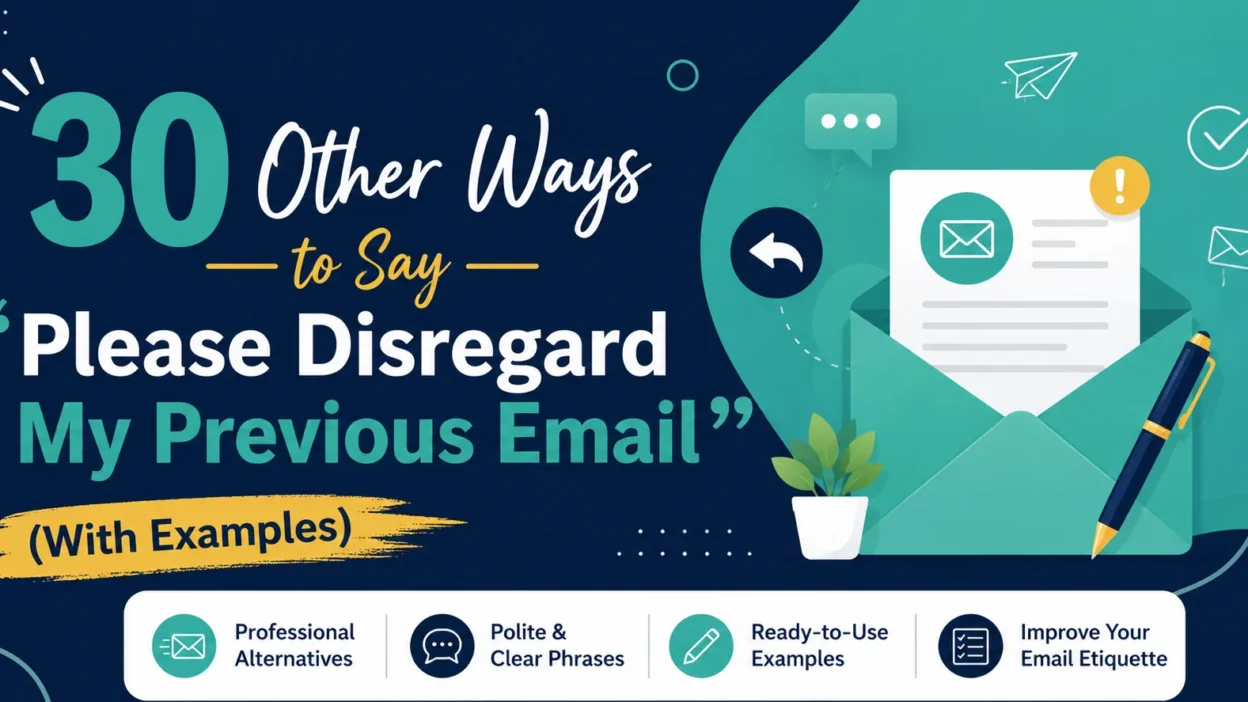
Other Ways to Say “Please Disregard My Previous Email” help you correct mistakes politely while keeping every message clear, professional, and respectful. In professional communication, small mistakes are almost impossible to avoid. You may send an email with the wrong attachment, incorrect information, or an outdated detail before you have time to review it. I have faced this myself, and I learned that a quick follow-up, correction email, or updated version prevents unnecessary confusion. While Please Disregard My Previous Email remains a common phrase, using alternative ways, synonyms, or more thoughtful alternatives creates a warmer impression. The right wording helps you clarify the message, protect your professionalism, and show genuine respect for the recipient.
Good email etiquette, a balanced professional tone, and clear communication matter whether you are writing to a colleague, client, manager, or another business contact. A sincere apology, a revised message, or a simple updated notice can acknowledge an error, rebuild trust, and improve every interaction. I have noticed that using warm, friendly, and considerate language makes an awkward situation much easier to handle. Instead of sounding abrupt, repetitive, or overly formal, your message feels more human, confident, and courteous, helping you maintain strong relationships while improving your communication skills.
Exploring alternatives, practical examples, and different phrasing gives you the flexibility to match various situations, contexts, and audiences. Whether your goal is a formal, neutral, or conversational reply, choosing the right words allows you to communicate with greater clarity, care, and honesty. A short follow-up message, polite resend message, or explanation with new information can fix email errors, correct a typo, replace an earlier message, and keep your business communication smooth, effective, and professional without making the reader feel uncomfortable.
What Does “Please Disregard My Previous Email” Mean?
The phrase “please disregard my previous email” is a polite request asking the recipient to ignore an earlier email because it contains outdated, incorrect, incomplete, or unnecessary information.
People commonly use this phrase when they:
- Sent the wrong attachment
- Included incorrect details
- Made a mistake
- Forgot important information
- Sent an email to the wrong audience
- Need to replace it with updated information
It helps avoid confusion and lets recipients know that a newer message should be considered the correct one.
Is It Professional or Polite to Say “Please Disregard My Previous Email”?
Yes. This phrase is both professional and polite, making it appropriate for business, academic, and formal communication.
However, using the exact same wording repeatedly can sound generic or repetitive. Depending on the situation, choosing a more specific alternative often makes your message feel clearer, friendlier, and more personal.
For example:
- If you’re correcting a mistake, acknowledge it.
- If you’re providing updated information, say so directly.
- If you’re replacing an attachment, explain which one to use.
Being transparent helps recipients understand exactly what happened.
Advantages and Disadvantages of Saying “Please Disregard My Previous Email”
Advantages
- Professional and widely understood.
- Prevents misunderstandings.
- Quickly clarifies that earlier information is no longer valid.
- Appropriate for nearly every workplace.
- Simple and respectful.
Disadvantages
- Can sound impersonal.
- Doesn’t explain why the previous email should be ignored.
- Feels repetitive if used frequently.
- May leave recipients with questions.
- Doesn’t always communicate urgency.
Synonyms for “Please Disregard My Previous Email”
- Please Ignore My Earlier Email
- Kindly Ignore My Previous Message
- Please Refer to This Updated Email Instead
- My Earlier Email Is No Longer Applicable
- Please Use This Version Instead
- Kindly Accept My Updated Information
- Please Consider This My Corrected Email
- I’ve Sent an Updated Version
- Please Disregard the Earlier Attachment
- The Previous Email Was Sent in Error
- Please Ignore My Last Message
- Please Treat This Email as the Correct One
- I’ve Made a Correction
- Please Refer to the Latest Information
- Kindly Replace My Previous Email With This One
- Please Use the Updated Details Below
- My Apologies—Please Ignore My Earlier Email
- Please Consider the Following Update
- I’ve Revised My Previous Email
- Please Note the Correct Information
- The Earlier Information Was Incorrect
- Please See My Updated Response
- Kindly Refer to This Corrected Version
- I’ve Included the Correct Attachment
- Please Ignore the Earlier Instructions
- This Email Supersedes My Previous One
- Please Accept This Revision
- Kindly Use This Information Going Forward
- This Message Replaces My Previous Email
- Please Refer Only to This Email
1. Please Ignore My Earlier Email
Meaning
A polite request asking someone to ignore the email you sent previously.
Definition
A straightforward replacement that tells the recipient the earlier message should no longer be considered.
Detailed Explanation
This is one of the closest alternatives to the original phrase. It sounds natural while remaining professional.
Scenario Example
“Please ignore my earlier email. The attached report includes the updated figures.”
Best Use
Business emails, workplace communication, and quick corrections.
Tone
Professional, polite, and direct.
2. Kindly Ignore My Previous Message
Meaning
Requests the recipient to overlook the earlier communication.
Definition
A courteous alternative using “kindly” for additional politeness.
Detailed Explanation
This version works especially well in formal correspondence.
Scenario Example
“Kindly ignore my previous message as it contained outdated information.”
Best Use
Formal business communication.
Tone
Respectful and formal.
3. Please Refer to This Updated Email Instead
Meaning
Directs readers toward the latest email.
Definition
Indicates that this message contains the correct information.
Detailed Explanation
Rather than simply asking someone to ignore an earlier email, this tells them exactly which email to follow.
Scenario Example
“Please refer to this updated email instead for the meeting schedule.”
Best Use
Updated announcements.
Tone
Helpful and informative.
4. My Earlier Email Is No Longer Applicable
Meaning
The previous email should no longer be used.
Definition
Explains that earlier information has become invalid.
Detailed Explanation
Useful when plans or instructions have changed.
Scenario Example
“My earlier email is no longer applicable due to today’s policy update.”
Best Use
Policy changes.
Tone
Professional.
5. Please Use This Version Instead
Meaning
Use this message rather than the previous one.
Definition
Introduces a replacement version.
Detailed Explanation
Especially useful when correcting attachments or documents.
Scenario Example
“Please use this version instead, as it includes the final edits.”
Best Use
Document revisions.
Tone
Friendly and clear.
6. Kindly Accept My Updated Information
Meaning
Requests recipients to rely on newly provided details.
Definition
A polite correction.
Detailed Explanation
Ideal for correcting facts or numbers.
Scenario Example
“Kindly accept my updated information regarding tomorrow’s presentation.”
Best Use
Professional updates.
Tone
Courteous.
7. Please Consider This My Corrected Email
Meaning
Treat this email as the accurate version.
Definition
Acknowledges that corrections have been made.
Detailed Explanation
Shows responsibility for an earlier mistake.
Scenario Example
“Please consider this my corrected email with the revised budget.”
Best Use
Formal corrections.
Tone
Professional and accountable.
8. I’ve Sent an Updated Version
Meaning
A new version has replaced the previous one.
Definition
Highlights that revisions have already been made.
Detailed Explanation
Simple and commonly used.
Scenario Example
“I’ve sent an updated version with the missing attachment.”
Best Use
File revisions.
Tone
Friendly.
9. Please Disregard the Earlier Attachment
Meaning
Ignore the previously attached file.
Definition
Clarifies that only the attachment is incorrect.
Detailed Explanation
Useful when the email itself is correct but the attachment isn’t.
Scenario Example
“Please disregard the earlier attachment and review the attached revised file.”
Best Use
Attachment corrections.
Tone
Professional.
10. The Previous Email Was Sent in Error
Meaning
The earlier email was mistakenly sent.
Definition
Acknowledges an accidental send.
Detailed Explanation
Accepts responsibility while correcting the issue.
Scenario Example
“The previous email was sent in error. Please refer to this one instead.”
Best Use
Accidental emails.
Tone
Honest and professional.
11. Please Ignore My Last Message
Meaning
Ignore the most recent email.
Definition
A casual alternative.
Detailed Explanation
Suitable when communicating with familiar colleagues.
Scenario Example
“Please ignore my last message—it included outdated pricing.”
Best Use
Internal teams.
Tone
Friendly.
12. Please Treat This Email as the Correct One
Meaning
This email replaces the previous one.
Definition
Establishes the latest email as authoritative.
Detailed Explanation
Removes uncertainty.
Scenario Example
“Please treat this email as the correct one moving forward.”
Best Use
Official corrections.
Tone
Confident.
13. I’ve Made a Correction
Meaning
An error has been fixed.
Definition
Introduces revised information.
Detailed Explanation
Simple and transparent.
Scenario Example
“I’ve made a correction to the schedule below.”
Best Use
Quick updates.
Tone
Professional.
14. Please Refer to the Latest Information
Meaning
Follow the newest details.
Definition
Points readers toward updated information.
Detailed Explanation
Works well when multiple updates exist.
Scenario Example
“Please refer to the latest information provided in this email.”
Best Use
Project updates.
Tone
Helpful.
15. Kindly Replace My Previous Email With This One
Meaning
Treat this email as the replacement.
Definition
A complete substitute for the earlier message.
Detailed Explanation
Very clear and professional.
Scenario Example
“Kindly replace my previous email with this one for your records.”
Best Use
Official documentation.
Tone
Formal.
16. Please Use the Updated Details Below
Meaning
The information below is correct.
Definition
Introduces revised details.
Detailed Explanation
Ideal when only certain facts changed.
Scenario Example
“Please use the updated details below regarding the event.”
Best Use
Schedules and logistics.
Tone
Professional.
17. My Apologies—Please Ignore My Earlier Email
Meaning
Offers an apology while correcting a mistake.
Definition
Combines courtesy with clarification.
Detailed Explanation
Shows accountability and professionalism.
Scenario Example
“My apologies—please ignore my earlier email and use the attached document.”
Best Use
Mistakes affecting recipients.
Tone
Warm and respectful.
18. Please Consider the Following Update
Meaning
Read the updated information carefully.
Definition
Introduces revised content.
Detailed Explanation
Less focused on the mistake and more on the solution.
Scenario Example
“Please consider the following update regarding our timeline.”
Best Use
Project communication.
Tone
Professional.
19. I’ve Revised My Previous Email
Meaning
Changes have been made.
Definition
Announces a corrected version.
Detailed Explanation
Useful for document revisions.
Scenario Example
“I’ve revised my previous email to include the missing details.”
Best Use
Editing communications.
Tone
Professional.
20. Please Note the Correct Information
Meaning
Pay attention to the revised details.
Definition
Highlights corrected facts.
Detailed Explanation
Ideal for fixing names, dates, or numbers.
Scenario Example
“Please note the correct information listed below.”
Best Use
Corrections.
Tone
Clear.
21. The Earlier Information Was Incorrect
Meaning
The previous details were wrong.
Definition
Acknowledges inaccurate information.
Detailed Explanation
Builds credibility through honesty.
Scenario Example
“The earlier information was incorrect. Please use the updated figures.”
Best Use
Data corrections.
Tone
Transparent.
22. Please See My Updated Response
Meaning
Review the corrected reply.
Definition
Points recipients toward a revised response.
Detailed Explanation
Useful in ongoing email conversations.
Scenario Example
“Please see my updated response below.”
Best Use
Email threads.
Tone
Professional.
23. Kindly Refer to This Corrected Version
Meaning
Use this corrected version.
Definition
A formal correction notice.
Detailed Explanation
Suitable for official communication.
Scenario Example
“Kindly refer to this corrected version of the proposal.”
Best Use
Business proposals.
Tone
Formal.
24. I’ve Included the Correct Attachment
Meaning
The proper file is attached.
Definition
Clarifies that only the attachment changed.
Detailed Explanation
Avoids confusion about which file to review.
Scenario Example
“I’ve included the correct attachment in this email.”
Best Use
Document sharing.
Tone
Helpful.
25. Please Ignore the Earlier Instructions
Meaning
The previous instructions are no longer valid.
Definition
Cancels earlier directions.
Detailed Explanation
Useful after process changes.
Scenario Example
“Please ignore the earlier instructions and follow these updated steps.”
Best Use
Operational updates.
Tone
Direct.
26. This Email Supersedes My Previous One
Meaning
This email officially replaces the earlier one.
Definition
A highly professional replacement statement.
Detailed Explanation
Common in corporate and legal communication.
Scenario Example
“This email supersedes my previous one regarding the contract.”
Best Use
Formal business communication.
Tone
Authoritative.
27. Please Accept This Revision
Meaning
This is the revised version.
Definition
Requests recipients to acknowledge updated information.
Detailed Explanation
Ideal after making corrections.
Scenario Example
“Please accept this revision as the final version.”
Best Use
Edited documents.
Tone
Professional.
28. Kindly Use This Information Going Forward
Meaning
Use these details from now on.
Definition
Establishes updated information.
Detailed Explanation
Helpful for long-term changes.
Scenario Example
“Kindly use this information going forward for all future reports.”
Best Use
Policy updates.
Tone
Respectful.
29. This Message Replaces My Previous Email
Meaning
The earlier email is no longer valid.
Definition
States that this message is the official replacement.
Detailed Explanation
Very clear and easy to understand.
Scenario Example
“This message replaces my previous email regarding tomorrow’s meeting.”
Best Use
General workplace communication.
Tone
Professional.
30. Please Refer Only to This Email
Meaning
Use only this email for guidance.
Definition
Eliminates confusion by identifying the correct message.
Detailed Explanation
Useful when multiple emails were sent.
Scenario Example
“Please refer only to this email for the finalized schedule.”
Best Use
Final announcements.
Tone
Clear, professional, and confident.
Conclusion
Choosing the right words after sending an incorrect email can make a big difference in how your message is received. While “Please Disregard My Previous Email” is a reliable option, using thoughtful alternatives helps you sound more professional, polite, and approachable. Whether you’re correcting a simple typo, replacing outdated information, or sending an updated version, a well-written follow-up shows respect, clarity, and professionalism. By matching your tone to the situation and following good email etiquette, you can fix mistakes confidently while maintaining strong relationships and clear communication.
FAQs
Q1. Is “Please Disregard My Previous Email” professional?
Yes. It is a professional and widely accepted phrase for asking someone to ignore an earlier email. However, using more natural alternatives can make your message sound warmer and less repetitive.
Q2. When should I use “Please Disregard My Previous Email”?
Use it when you’ve sent incorrect information, attached the wrong file, emailed the wrong recipient, or need to replace your original message with an updated version.
Q3. What can I say instead of “Please Disregard My Previous Email”?
You can use alternatives such as:
- Kindly ignore my previous email.
- Please ignore my last message.
- I’ve sent an updated version—please refer to that instead.
- My previous email contained an error; please see the corrected version below.
- Apologies for the confusion. Please use the updated information instead.
Q4. Should I apologize when correcting an email?
A brief apology is recommended, especially if the mistake may have caused confusion or inconvenience. A simple apology followed by the corrected information is usually enough.
Q5. How can I avoid sending correction emails in the future?
Review your email before sending, double-check attachments and recipients, verify important details, and use features like Undo Send (available in services such as Gmail) whenever possible. Taking a few extra seconds to proofread can help prevent unnecessary follow-up emails.