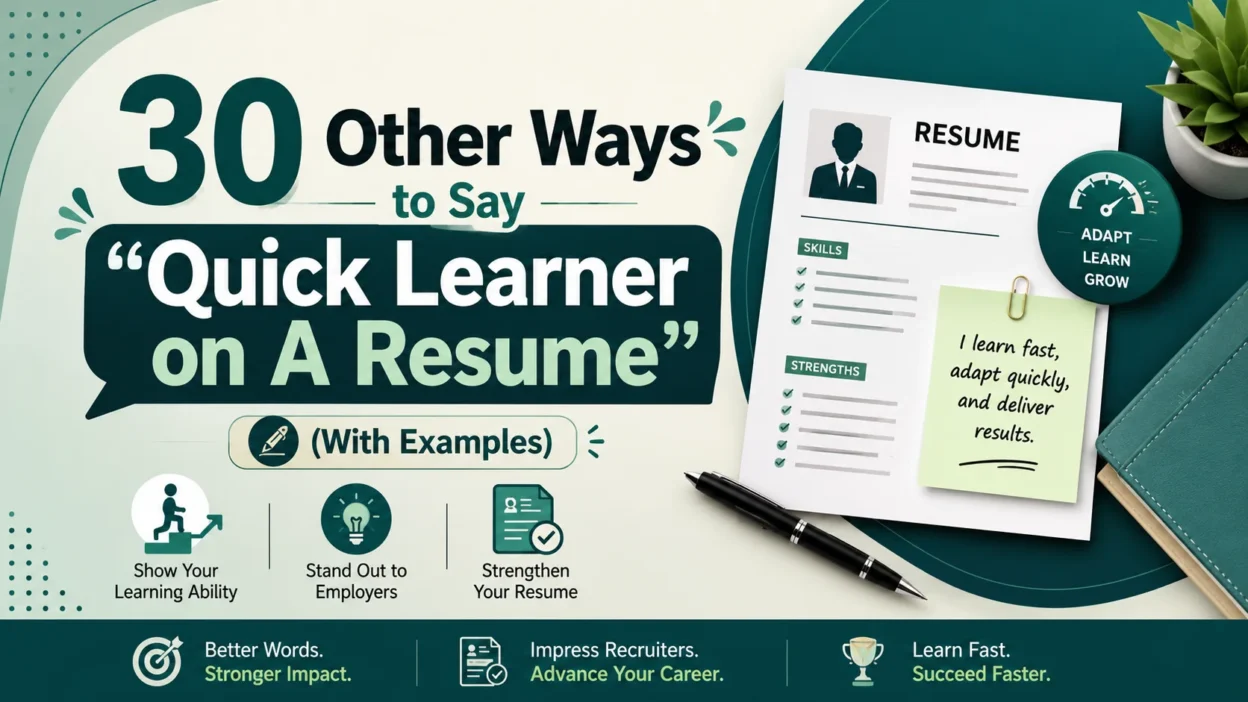
The phrase other ways to say Quick learner on A Resume helps present a quick learner with a stronger resume, stronger profile, and stronger impact. Choosing other ways to say quick learner instead of an overused, generic, vague, forgettable, plain, or basic repeated phrase makes your resume, CV, cover letter, LinkedIn profiles, career profile, or blog post sound more natural. Using resume-ready alternatives, alternative phrases, alternatives, synonyms, options, phrases, words, and clear language helps communicate value. The right keywords, LSI keywords, NLP–friendly phrases, vocabulary, meaning, meanings, usage tips, explanations, tone, tone explanations, examples, real examples, scenarios, and real–life scenarios can help candidates, job seekers, students, fresh graduates, entry-level candidates, professionals, and experienced professionals stand out in every career level, industry, and job market. From my own experience reviewing resumes, small wording changes often make a profile feel much stronger.
Good wording also shows employers, prospective employers, recruiters, common recruiters, hiring managers, and applicant tracking systems like ATS that you have the ability, abilities, learning ability, learning agility, learning capabilities, adaptability, and an adaptable mindset. It highlights how you adapt, adapts, adapting, adapt fast, show flexibility, stay flexible, demonstrate trainability, become highly trainable, work as a fast adapter, act as a self-starter, achieve rapid skill acquisition, improve skill acquisition, build skills, gain new skills, support skill development, use your talents, strengths, qualities, unique qualities, special qualities, capabilities, potential, curiosity, comprehension, problem solving, problem-solving skills, growth, professional growth, growth mindset, knowledge, information, instructions, ideas, continue learning, learns, learns quickly, learn quickly, remain eager to learn, show eagerness to learn, understand, improve, applies knowledge, picks up skills, pick up new skills, picking up skills, and hit the ground running with visible skills in every role, roles, job, early career, career, learning environment, project environment, class environment, workplace, team, project, class, and environment.
Using specific, clearer, polished, polished alternatives with a professional, personal, meaningful, thoughtful, descriptive, genuine, genuinely, warmly, and warm style creates positive energy, empathy, and connection that resonate with readers. It builds confidence, helps you sound confident, credible, experienced, and effective, lets you effectively communicate, articulate, articulate strengths, showcase skills, showcase abilities, refine resumes, master alternative phrases, excel, thrive, and follow a useful guide that makes your profile more memorable. Strong communication, professional communication, communication skills, feedback, acknowledgment, appreciation, admiration, recognition, compliments, compliment, and praise are valuable during a job interview, training setting, performance reviews, workplace review, team discussions, and conversations because they match employer expectations, improve your chances of landing gigs, landing the perfect job, and succeeding in hiring. This article is designed to help your strengths shine.
What Does “Quick Learner” Mean?
A quick learner is someone who can understand new information, develop new skills, and adapt to unfamiliar situations in a short amount of time. Employers value this quality because it often means less training, faster productivity, and greater flexibility.
Being a quick learner also suggests that you are:
- Adaptable
- Curious
- Self-motivated
- Open to feedback
- Problem-solving oriented
- Eager to improve
On a resume, replacing this phrase with stronger alternatives can make your qualifications sound more professional and specific.
Is It Professional to Say “Quick Learner” on a Resume?
Yes, but not always.
Although “quick learner” is perfectly acceptable, recruiters see it on countless resumes. Without supporting evidence, it may sound generic.
Instead of simply saying you’re a quick learner, use more descriptive phrases that demonstrate how you learn, adapt, and contribute.
For example:
❌ Quick learner with strong communication skills.
✅ Rapidly adapts to new technologies and consistently masters new software with minimal supervision.
The second example is much stronger because it provides context.
Advantages and Disadvantages of Saying “Quick Learner”
Advantages
- Easy for recruiters to understand
- Shows adaptability
- Suggests willingness to grow
- Works well in many industries
- Highlights learning potential
Disadvantages
- Very common
- Can sound vague
- Doesn’t provide proof
- Less memorable than stronger alternatives
- May not distinguish you from other candidates
Synonyms for “Quick learner on A Resume”
- Fast Learner
- Rapid Learner
- Adaptable Professional
- Quick to Master New Skills
- Eager to Learn
- Highly Adaptable
- Agile Learner
- Fast to Acquire New Skills
- Continuous Learner
- Self-Motivated Learner
- Growth-Oriented Professional
- Knowledge Seeker
- Skilled at Learning New Systems
- Learns New Concepts Quickly
- Resourceful Professional
- Flexible Team Member
- Quick to Adapt
- Proactive Learner
- Naturally Curious
- Rapid Skill Developer
- Efficient Knowledge Builder
- Innovative Thinker
- Self-Directed Learner
- Versatile Professional
- Open to Learning
- Trainable Professional
- Continuous Improvement Mindset
- Excels in Learning New Processes
- Strong Problem Solver
- Accelerated Learner
1. Fast Learner
Meaning
Someone who understands new information quickly.
Definition
A professional who gains knowledge and skills faster than average.
Detailed Explanation
This is one of the closest alternatives and sounds slightly stronger than “quick learner.”
Scenario Example
“Recognized as a fast learner, mastering new CRM software within one week.”
Best Use
Customer service, administration, sales.
Tone
Professional, confident
2. Rapid Learner
Meaning
Able to absorb knowledge in a short time.
Definition
Someone who develops competency quickly.
Detailed Explanation
Adds a more formal tone suitable for resumes.
Scenario Example
“Rapid learner who quickly adapted to new compliance procedures.”
Best Use
Corporate resumes.
Tone
Formal
3. Adaptable Professional
Meaning
Adjusts easily to change.
Definition
A person who thrives in new environments.
Detailed Explanation
Focuses on flexibility rather than speed.
Scenario Example
“Adaptable professional experience in changing work environments.”
Best Use
Project management.
Tone
Professional
4. Quick to Master New Skills
Meaning
Learn practical abilities quickly.
Definition
Develops competence with minimal training.
Detailed Explanation
Shows results rather than simply claiming to learn fast.
Scenario Example
“Quick to master new software platforms.”
Best Use
Technical positions.
Tone
Confident
5. Eager to Learn
Meaning
Always willing to improve.
Definition
Shows enthusiasm for gaining knowledge.
Detailed Explanation
Highlights motivation more than speed.
Scenario Example
“Eager to learn emerging technologies.”
Best Use
Entry-level jobs.
Tone
Positive
6. Highly Adaptable
Meaning
Comfortable with change.
Definition
Able to adjust efficiently.
Detailed Explanation
Employers value adaptability in fast-paced workplaces.
Scenario Example
“Highly adaptable in rapidly changing environments.”
Best Use
Healthcare, IT.
Tone
Professional
7. Agile Learner
Meaning
Learn efficiently while adapting.
Definition
Someone who responds quickly to new challenges.
Detailed Explanation
Popular in business and leadership settings.
Scenario Example
“Agile learner with experience managing multiple systems.”
Best Use
Business roles.
Tone
Modern
8. Fast to Acquire New Skills
Meaning
Builds abilities quickly.
Definition
Develops practical knowledge efficiently.
Detailed Explanation
Shows continuous professional growth.
Scenario Example
“Fast to acquire new technical certifications.”
Best Use
Technology.
Tone
Professional
9. Continuous Learner
Meaning
Always learning.
Definition
Committed to lifelong improvement.
Detailed Explanation
Employers appreciate people dedicated to professional development.
Scenario Example
“Continuous learner who regularly completes online certifications.”
Best Use
Professional careers.
Tone
Growth-focused
10. Self-Motivated Learner
Meaning
Learn independently.
Definition
Doesn’t require constant supervision.
Detailed Explanation
Shows initiative and responsibility.
Scenario Example
“Self-motivated learner who independently mastered Excel automation.”
Best Use
Remote work.
Tone
Professional
11. Growth-Oriented Professional
Meaning
Focused on continuous improvement.
Definition
Always seeks opportunities to develop.
Detailed Explanation
Reflects a growth mindset.
Scenario Example
“Growth-oriented professionals committed to expanding technical expertise.”
Best Use
Leadership.
Tone
Positive
12. Knowledge Seeker
Meaning
Passionate about learning.
Definition
Actively searches for new information.
Detailed Explanation
Emphasizes curiosity.
Scenario Example
“Knowledge seeker with a passion for innovation.”
Best Use
Research.
Tone
Inspirational
13. Skilled at Learning New Systems
Meaning
Learn software quickly.
Definition
Comfortable adopting new technologies.
Detailed Explanation
Very useful for technical resumes.
Scenario Example
“Skilled at learning new systems with minimal onboarding.”
Best Use
IT.
Tone
Technical
14. Learns New Concepts Quickly
Meaning
Grasps ideas rapidly.
Definition
Processes information efficiently.
Detailed Explanation
Simple yet effective.
Scenario Example
“Learn new concepts quickly and apply them immediately.”
Best Use
General resumes.
Tone
Professional
15. Resourceful Professional
Meaning
Find effective solutions.
Definition
Uses available resources wisely.
Detailed Explanation
Suggests independent learning.
Scenario Example
“Resourceful professional who solves unfamiliar challenges.”
Best Use
Operations.
Tone
Confident
16. Flexible Team Member
Meaning
Works well with change.
Definition
Adjusts to new responsibilities.
Detailed Explanation
Highlights collaboration.
Scenario Example
“Flexible team members supporting multiple departments.”
Best Use
Team-based jobs.
Tone
Friendly
17. Quick to Adapt
Meaning
Adjusts rapidly.
Definition
Responds effectively to change.
Detailed Explanation
Focuses on adaptability.
Scenario Example
“Quick to adapt to evolving customer needs.”
Best Use
Customer service.
Tone
Professional
18. Proactive Learner
Meaning
Learn before being asked.
Definition
Take initiative.
Detailed Explanation
Shows ownership.
Scenario Example
“Proactive learner who completed industry certifications independently.”
Best Use
Professional roles.
Tone
Confident
19. Naturally Curious
Meaning
Interested in discovering new knowledge.
Definition
Driven by curiosity.
Detailed Explanation
Shows intrinsic motivation.
Scenario Example
“Naturally curious professionals exploring emerging technologies.”
Best Use
Creative careers.
Tone
Friendly
20. Rapid Skill Developer
Meaning
Builds expertise quickly.
Definition
Develops competencies efficiently.
Detailed Explanation
Highlights measurable improvement.
Scenario Example
“Rapid skill developer recognized for quick onboarding.”
Best Use
Technical fields.
Tone
Professional
21. Efficient Knowledge Builder
Meaning
Gains knowledge efficiently.
Definition
Learn systematically.
Detailed Explanation
Suggests structured learning.
Scenario Example
“Efficient knowledge builder with strong analytical abilities.”
Best Use
Business analysis.
Tone
Formal
22. Innovative Thinker
Meaning
Creates new ideas.
Definition
Combines learning with creativity.
Detailed Explanation
Shows adaptability and innovation.
Scenario Example
“Innovative thinker who quickly implemented process improvements.”
Best Use
Innovation roles.
Tone
Creative
23. Self-Directed Learner
Meaning
Learn independently.
Definition
Requires minimal supervision.
Detailed Explanation
Ideal for remote work.
Scenario Example
“Self-directed learner experienced in online professional development.”
Best Use
Remote jobs.
Tone
Professional
24. Versatile Professional
Meaning
Has many abilities.
Definition
Capable of performing different tasks.
Detailed Explanation
Shows flexibility and learning.
Scenario Example
“Versatile professional managing diverse responsibilities.”
Best Use
Management.
Tone
Professional
25. Open to Learning
Meaning
Welcome new knowledge.
Definition
Accepts feedback positively.
Detailed Explanation
Shows coachability.
Scenario Example
“Open to learning and continuous improvement.”
Best Use
Entry-level.
Tone
Positive
26. Trainable Professional
Meaning
Learn through instruction.
Definition
Responds well to coaching.
Detailed Explanation
Demonstrates willingness to grow.
Scenario Example
“Trainable professional with excellent teamwork skills.”
Best Use
New graduates.
Tone
Professional
27. Continuous Improvement Mindset
Meaning
Always improving.
Definition
Committed to ongoing development.
Detailed Explanation
Popular in Lean and Six Sigma environments.
Scenario Example
“Maintains a continuous improvement mindset.”
Best Use
Manufacturing.
Tone
Formal
28. Excels in Learning New Processes
Meaning
Learn workflows quickly.
Definition
Efficiently understands procedures.
Detailed Explanation
Highlights operational excellence.
Scenario Example
“Excels in learning new processes during organizational change.”
Best Use
Operations.
Tone
Professional
29. Strong Problem Solver
Meaning
Find effective solutions.
Definition
Analyzes challenges logically.
Detailed Explanation
Often implies learning while solving problems.
Scenario Example
“Strong problem solver with excellent analytical thinking.”
Best Use
Engineering.
Tone
Confident
30. Accelerated Learner
Meaning
Develops expertise at a fast pace.
Definition
Achieves proficiency faster than expected.
Detailed Explanation
A polished alternative that sounds modern and achievement-oriented.
Scenario Example
“Accelerated learner who became a team trainer within six months.”
Best Use
Leadership development programs and fast-paced industries.
Tone
Professional, ambitious
Conclusion
Finding the best other ways to say quick learner on a resume can make a real difference in how employers see your application. Instead of relying on a phrase that many people use, choose words that clearly show your adaptability, learning agility, problem-solving skills, and professional growth. Strong, specific language helps your resume, CV, and LinkedIn profile stand out while giving recruiters a better picture of your abilities.
The best alternative is always the one that matches your real experience. Whether you are a student, fresh graduate, entry-level candidate, or experienced professional, using honest and meaningful language shows confidence and credibility. When your achievements are supported with clear examples, hiring managers are more likely to notice your potential and see the value you can bring to the role.
FAQs
Q1. What are the best other ways to say quick learner on a resume?
Some of the best alternatives include adaptable, highly trainable, fast adapter, self-starter, and phrases that highlight learning agility, skill development, and rapid skill acquisition. Choose the wording that best matches your experience.
Q2. Should I avoid using “quick learner” on my resume?
You do not have to avoid it completely, but using more specific alternatives often makes your resume stronger. Recruiters see the phrase frequently, so a more descriptive expression can help you stand out.
Q3. How can I prove that I am a quick learner?
Support your claim with real achievements. Mention how you learned a new tool, completed training quickly, adapted to a new role, or solved a problem using newly acquired skills. Concrete examples are more convincing than simple statements.
Q4. Do applicant tracking systems recognize alternative phrases?
Yes. Most applicant tracking systems (ATS) recognize relevant keywords related to learning, adaptability, and professional skills. Using natural, job-related language along with keywords from the job description can improve your resume’s relevance.
Q5. Which alternative works best for fresh graduates?
Learning agility, eager to learn, adaptable, and highly trainable are excellent choices for fresh graduates and entry-level candidates. These phrases emphasize potential, willingness to grow, and the ability to learn quickly, even with limited work experience.